
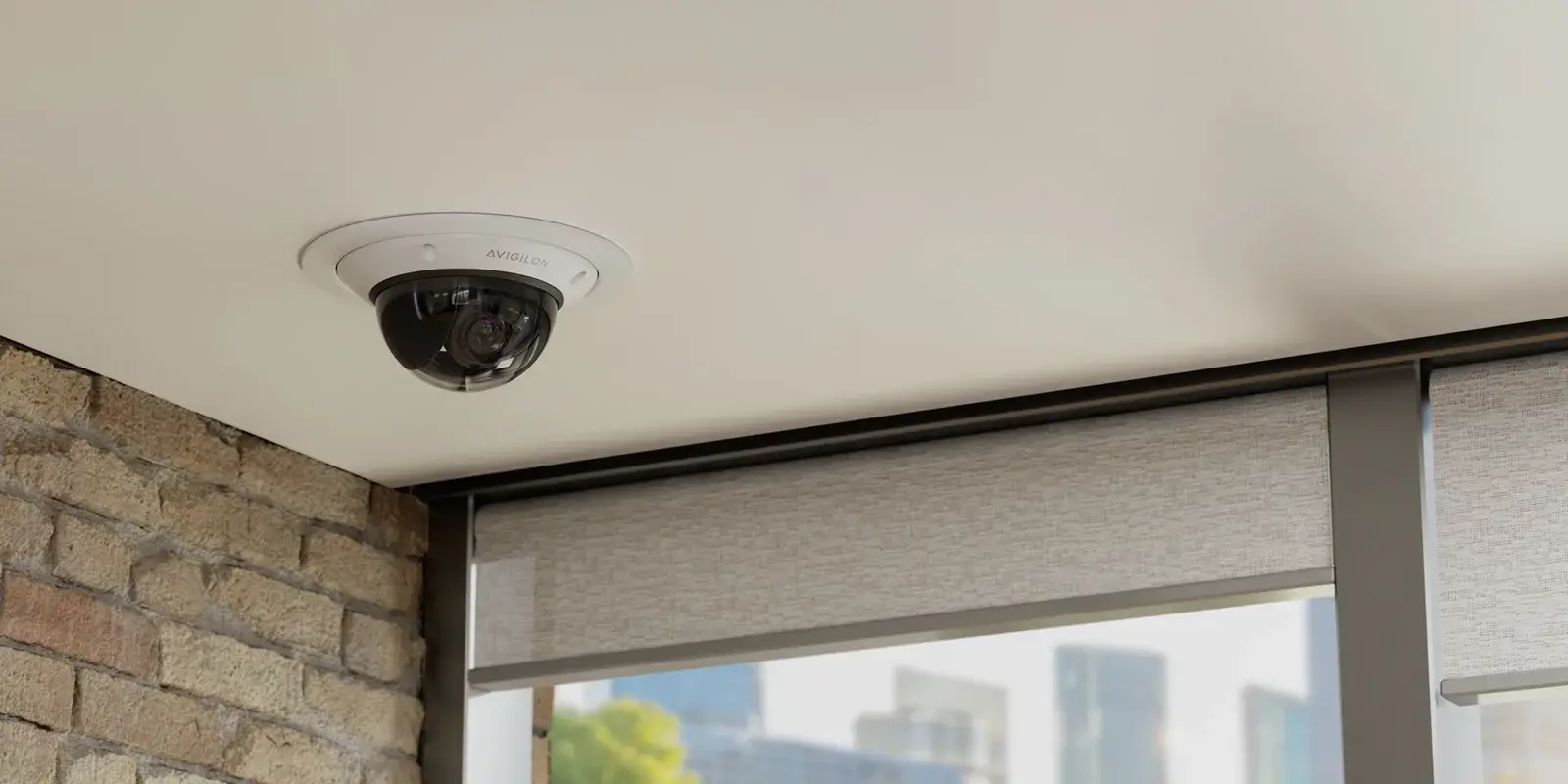
The short version: a fixed dome gives you a discreet, fixed view in a compact
housing. A bullet gives you a directional, visible view along a defined approach.
A PTZ gives an operator a movable view across a wide area. A thermal
camera detects heat rather than visible light, which is useful where lighting and visibility are
the problem.
Most commercial properties end up using more than one of these. The useful question is not
“which camera type is best” but “what does each specific position need to show?” This guide covers
what each category actually does, where it fits, and the planning decisions that matter more than
the housing shape.
Avigilon camera types at a glance
| Factor | Fixed dome | Bullet | PTZ | Thermal |
|---|---|---|---|---|
| Primary role | Fixed view in a compact housing | Directional view along an approach | Operator-controllable movement and zoom | Heat-based observation |
| Fixed or movable | Fixed | Fixed | Movable (pan, tilt, zoom) | Fixed |
| Typical placement | Entrances, lobbies, corridors, interiors | Exterior approaches, loading areas, perimeters | Large yards, parking areas, wide open sites | Perimeters and low-visibility scenes |
| Visibility to people on site | Discreet, low-profile | Visible and directional | Visible, often prominent | Varies by housing and mounting |
| Best at | Consistent coverage of a known scene | Watching a specific route or entry point | Covering wide areas with active control | Detecting presence where light is poor |
| Main planning consideration | Mounting height and perspective | Whether the chosen field of view stays useful | What is not recorded while it looks elsewhere | Detection vs. identification objectives |
Avigilon groups its cameras into these families on its own
IP camera
range, with thermal listed among specialty cameras and sensors. ACG’s
Avigilon video cameras hub covers the
current families in more detail.
When to choose a fixed dome camera
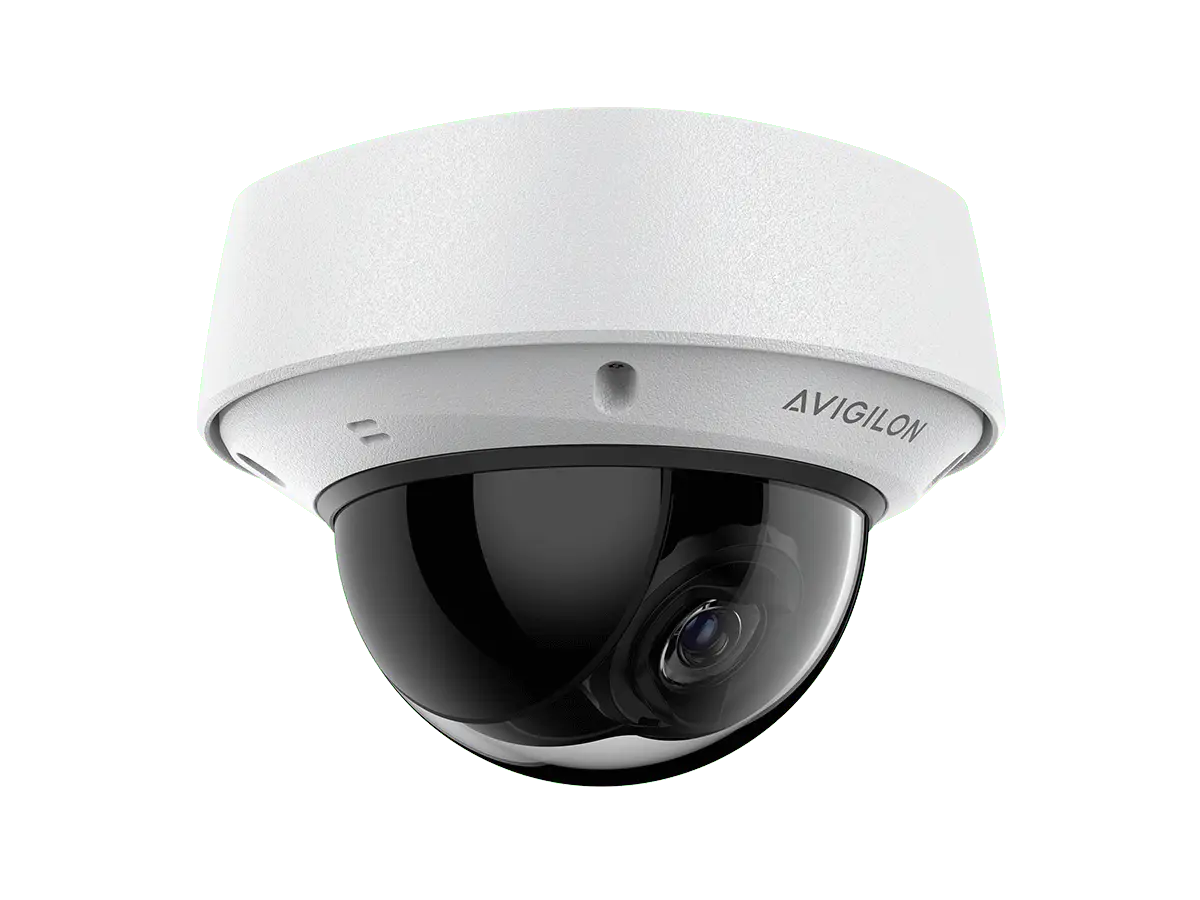
view.
A fixed dome is the default choice for interior and entrance coverage. The compact housing sits
close to the ceiling or soffit, which tends to look less intrusive in customer-facing and workplace
environments, and the fixed field of view means the scene you commission is the scene you keep.
Avigilon’s current dome range includes the H6A Dome, which it describes as offering video and
audio analytics built in, and the H6X Dome, positioned for on-premise Unity deployments and designed
without a built-in microphone. That distinction matters in environments where an organisation has a
specific position on audio.
Choose a dome when the scene is known and stable: a reception area, a corridor, a till point, a
building entrance. Do not choose one simply because it is discreet — mounting height, subject
distance and lighting still determine whether the recorded video is useful. ACG’s
Avigilon fixed dome cameras page covers
the selection detail.
When to choose a bullet camera
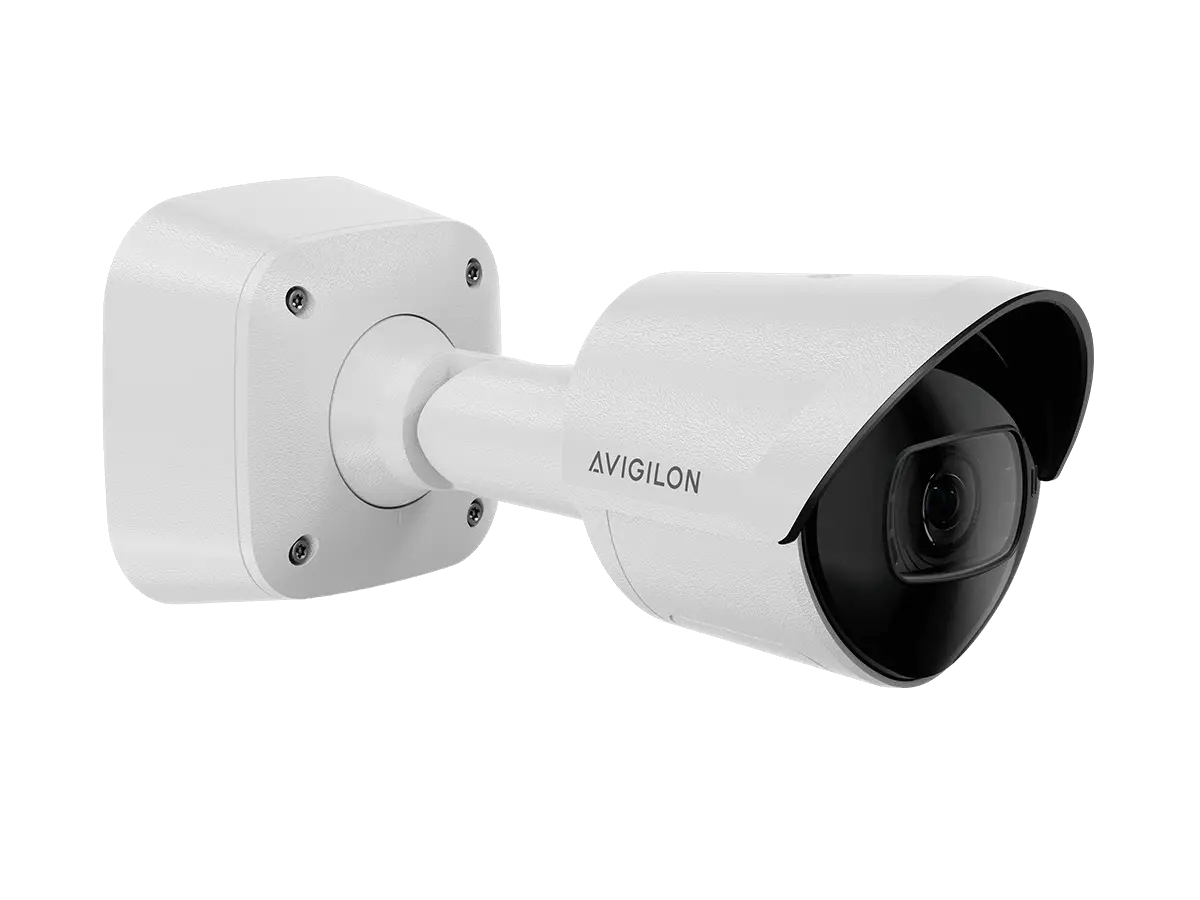
and perimeters.
A bullet camera is directional and obvious. Avigilon describes its bullet range as providing
long-range video coverage for indoor and outdoor environments, and the visible form factor is often
part of the point: people can see where the camera is pointing.
Bullets suit exterior approaches, loading-dock lanes, parking rows, fence lines and long
corridors — anywhere the value comes from watching a particular direction of travel. The current
family includes H6A and H6X variants with different platform and audio characteristics, so the
version matters as much as the category.
The planning question for a bullet is whether the chosen field of view stays useful throughout
normal site activity. A loading area changes when trailers park in it. A perimeter changes as
vegetation grows. See ACG’s
Avigilon bullet cameras page for more.
When a PTZ camera makes sense
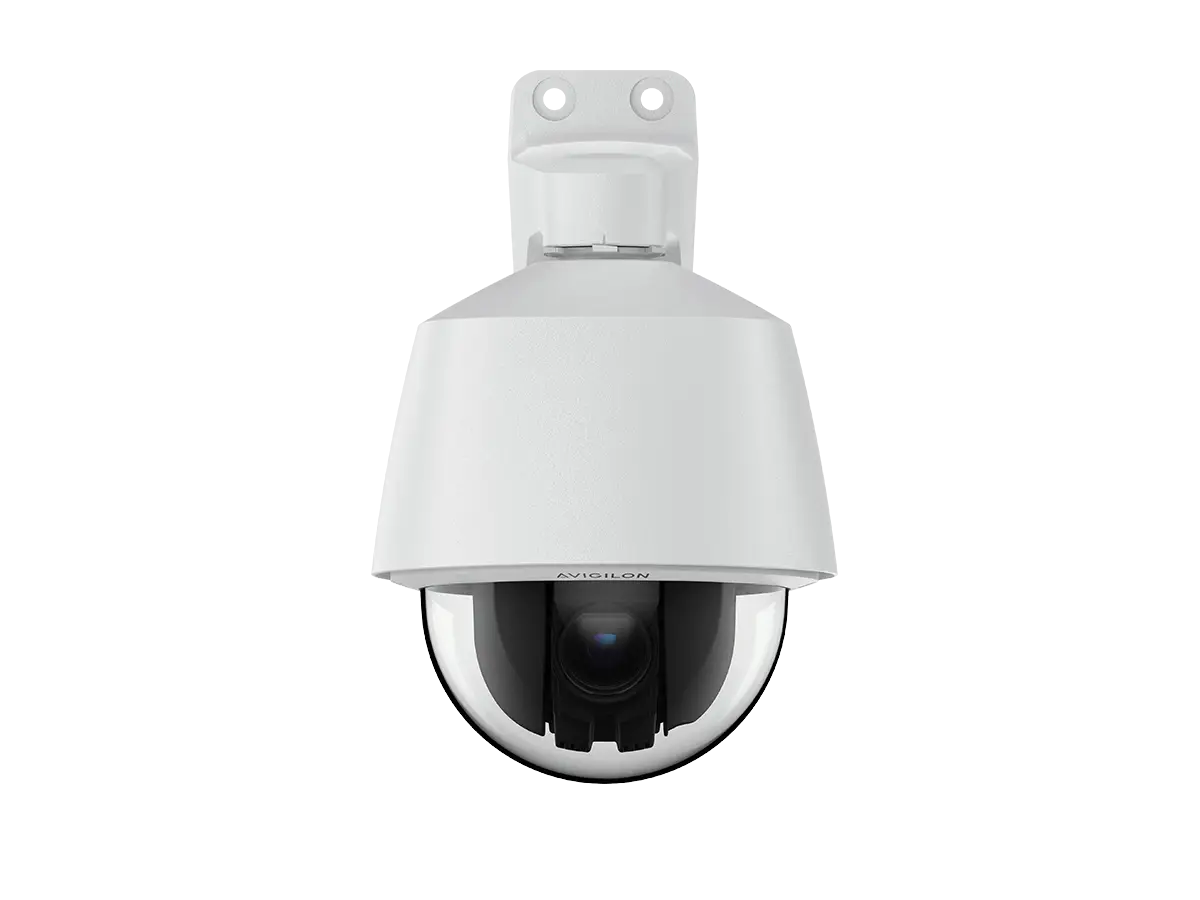
facing.
A PTZ camera can pan, tilt and zoom, which lets one device cover a large area such as a yard,
a parking lot or an open campus. Avigilon positions PTZ cameras for observing large indoor and
outdoor areas with optical zoom rather than digital cropping.
Here is the point that causes the most confusion, so it is worth stating plainly:
a PTZ camera does not watch every direction at once just because it is capable of moving.
At any given moment it is recording the direction it is pointing. If it is zoomed into the north
gate, it is not recording the south fence. Movement is a capability, not simultaneous coverage.
That has a practical consequence: PTZ cameras work best alongside fixed cameras, not instead of
them. The fixed cameras provide the continuous record; the PTZ provides reach and detail when
someone — or a configured workflow — directs it. ACG’s
Avigilon PTZ cameras page covers how to plan
that relationship.
When thermal imaging is appropriate
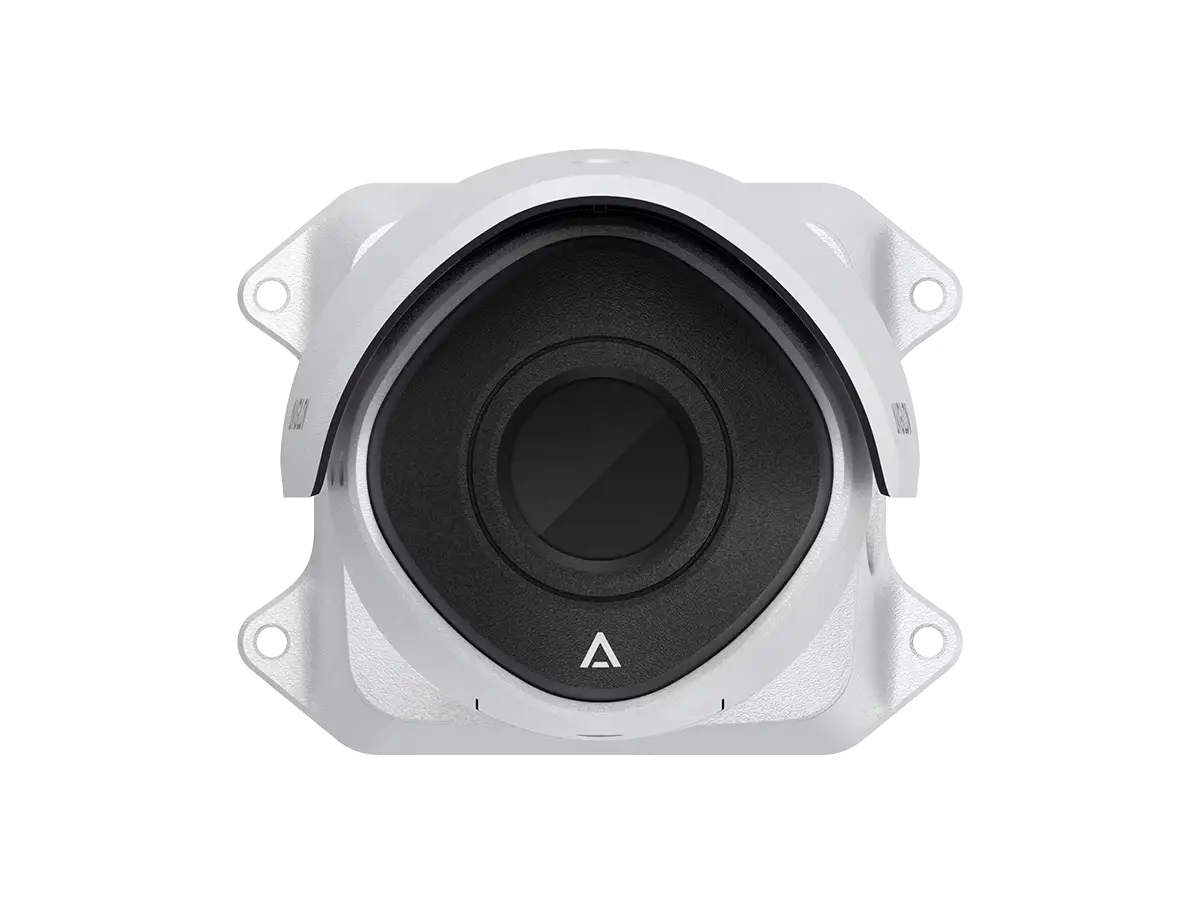
A thermal camera forms its image from heat rather than visible light. Avigilon describes the H5A
Thermal camera as protecting the perimeter using heat-sensing technology together with AI-powered
video analytics to detect people and vehicles, and notes it can see more in poor visibility.
That makes thermal genuinely useful where lighting is the limitation: unlit perimeters, areas
with glare or deep shadow, or scenes where visible-light cameras struggle. It answers “is someone
there?” far better than it answers “who is that?” — thermal imagery does not provide the visible
identifying detail a colour camera does. Treat detection and identification as separate design
objectives.
Avigilon does document radiometric alarm capability within the H5A Thermal family, which relates
to temperature-based alerting. That is a specific, configurable capability with its own
requirements — it is not a general claim that a security camera will detect fires or predict
equipment failure, and it should not be specified as one. Confirm the exact variant and
configuration for any temperature-related requirement. ACG’s
Avigilon thermal cameras page covers the
scoping questions.
Why many commercial properties use more than one camera type
A single property rarely has a single kind of problem. A distribution facility might need
discreet interior coverage at the office entrance, directional coverage down the loading lanes,
wide-area reach across the trailer yard and heat-based detection along an unlit rear boundary. That
is four different questions, and the honest answer involves more than one camera type.
Mixing types is normal and expected. What matters is that each device is chosen for a defined
job rather than because it was the standard model on the last quotation.
Camera placement matters as much as camera type
Two identical cameras can produce completely different results depending on where they are
mounted. Before selecting hardware, it is worth confirming for each position:
- What the view is actually for — general observation, event review, or identifying detail
- Subject distance and the amount of detail required at that distance
- Mounting height and angle, and whether people or vehicles will pass too close beneath
- Lighting through a full day and night cycle, including backlight and glare
- Obstructions that change: parked vehicles, stock, seasonal vegetation
- How the camera will be reached for service without disrupting operations
Getting these right will do more for image usefulness than upgrading to a higher-specification
camera in the wrong position.
How video management affects the design
Cameras are only half of the system. The platform that records, displays and searches the video
determines what your team can actually do with it, and it constrains which cameras are appropriate.
Avigilon offers both on-premise and cloud-oriented approaches, and the choice affects onboarding,
administration and retention planning.
Camera and platform decisions should therefore be made together, not sequentially. ACG’s
Avigilon video management page explains
the platform decision, and the
video analytics service covers the review and alerting
workflows that often drive camera placement in the first place.
How ACG selects the camera mix
ACG Security Solutions starts with the events your team needs to understand, not with a product
list. We review the scenes, distances, lighting and mounting options, confirm what the existing
infrastructure can support, and then match camera types to positions.
We also verify the exact current model and platform support before specifying, because product
families evolve and similar-looking cameras are not necessarily interchangeable across
environments. The broader
commercial video surveillance service covers
complete system planning beyond a single manufacturer or camera category.
Get the camera mix right for your property
Tell us which areas need attention, what your team needs to be able to review afterwards and
what is already installed. We can turn that into an Avigilon camera plan that puts the right camera
type in each position.
MOTOROLA, MOTO, MOTOROLA SOLUTIONS and the Stylized M Logo are trademarks or registered
trademarks of Motorola Trademark Holdings, LLC and are used under license. All other trademarks are
the property of their respective owners.
Comments are closed for this article!