COMMERCIAL ACCESS SECURITY
Commercial Access Control Systems
A commercial access control system helps an organization determine who can enter specific doors or controlled areas, how authorization is verified, when access is permitted and how entry activity is administered. Instead of relying only on traditional keys, businesses can use electronic credentials and centralized management to support more controlled movement through a facility.
ACG Security Solutions helps commercial and enterprise organizations evaluate card and fob credentials, mobile credentials, biometric readers, PIN-based entry, multi-factor approaches and the controllers, door hardware and software required to support them.
The right system depends on the property, the number and type of doors, daily traffic, existing hardware, network availability and the organization’s credential policies. ACG approaches access control as a facility-design problem rather than simply selecting a reader and placing it beside a door.
Commercial access control planning for organizations in Georgia, the Southeast and qualifying projects nationwide.
What is a commercial access control system?
A commercial access control system manages authorization at doors, gates or restricted areas by requiring an approved credential before access is granted. The credential may be a card, fob, mobile device, biometric characteristic, PIN or another approved method supported by the selected system.
The system typically includes more than the visible reader. Door hardware, controllers, power, network connectivity, management software, credential policies and the way access events are recorded all influence how the system performs.
Electronic access control can make it easier to change authorization without physically replacing locks or issuing new mechanical keys across an entire property. An organization can establish different permissions for employees, contractors, visitors or restricted operating areas according to its requirements.
Access control is also frequently planned alongside commercial video surveillance, gates, intrusion alarms and other security systems. The strongest design starts by understanding the facility and its operating rules before selecting hardware.
How people are credentialed for commercial access
There is no single credential method that is appropriate for every organization. The selected approach should reflect the facility, user population, risk level, administration requirements and existing technology.
Key cards and fobs
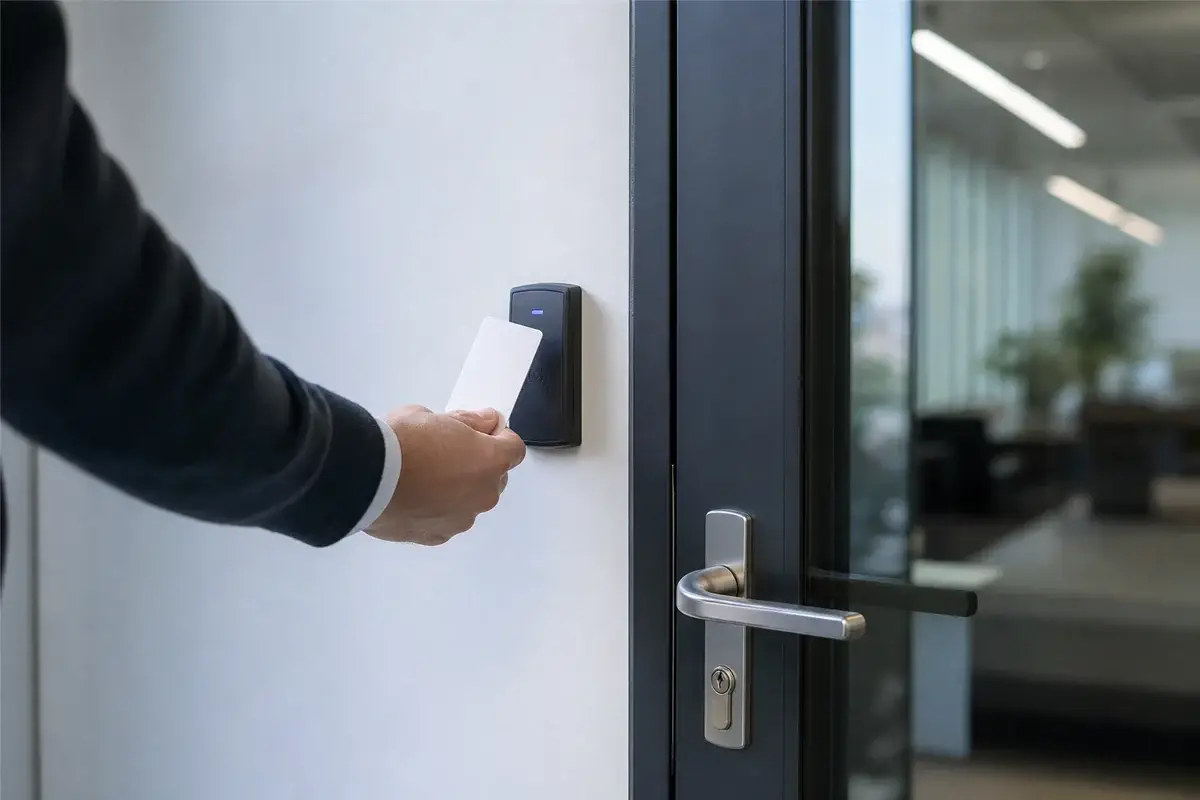
Cards and fobs remain common electronic credentials because they provide a practical way to assign and revoke access without distributing traditional keys. Their suitability depends on the reader technology, credential policy and level of control the organization requires.
Mobile credentials
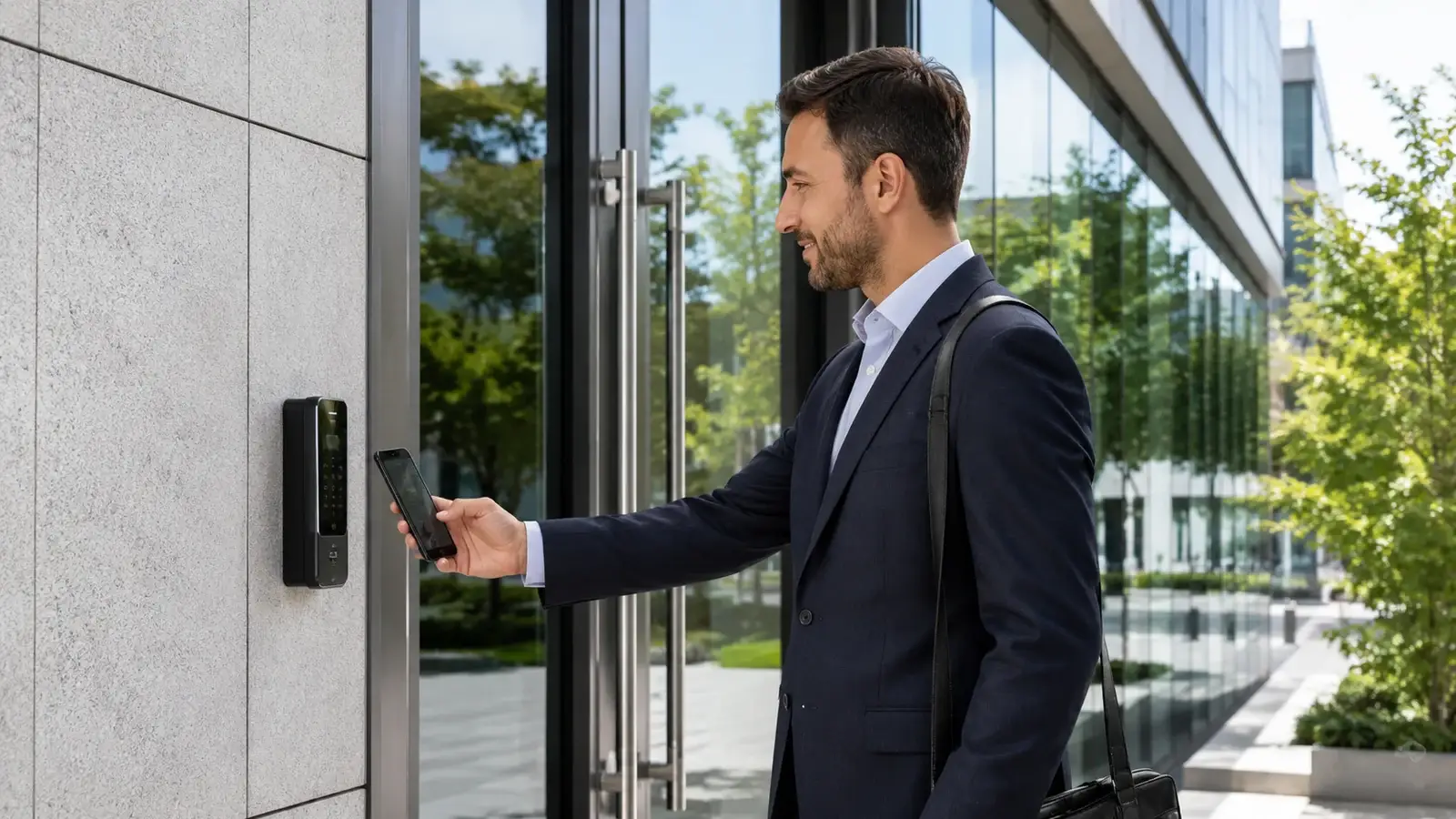
A mobile credential can allow a compatible smartphone or mobile device to participate in the access process. Mobile approaches may reduce dependence on separate physical credentials, but compatibility, user enrollment and administrative requirements should be evaluated before deployment.
Biometric readers
Biometric access control uses a physical characteristic such as a fingerprint, face or iris as part of identity verification. Biometrics can be useful where an organization wants the credential to be tied more directly to the individual, but modality selection, privacy policies, enrollment and system compatibility should be considered carefully.
PIN and keypad entry
A PIN or keypad can provide another method of authorization and may be appropriate for selected doors or operating workflows. Because a code can potentially be shared, the security objective should determine whether PIN entry is used alone or combined with another credential.
Multi-factor entry
Some controlled areas may require more than one form of verification. A multi-factor approach can combine credential types when the facility’s security requirements justify an additional authorization step.
Visitor and contractor credentials
Visitors, vendors and contractors may require temporary or limited access that differs from employee permissions. A well-planned system should account for how temporary users are approved, how long access remains valid and which areas they are allowed to enter.
Doors, areas and entry points worth controlling
Access control is most useful when the organization first decides which doors or spaces actually require managed authorization. Main employee entrances, restricted offices, technology rooms, equipment areas and other controlled spaces may each require different policies.
The physical door matters as much as the credential. Door type, locking hardware, egress requirements, existing electrified hardware and the condition of the frame can affect what equipment is appropriate.
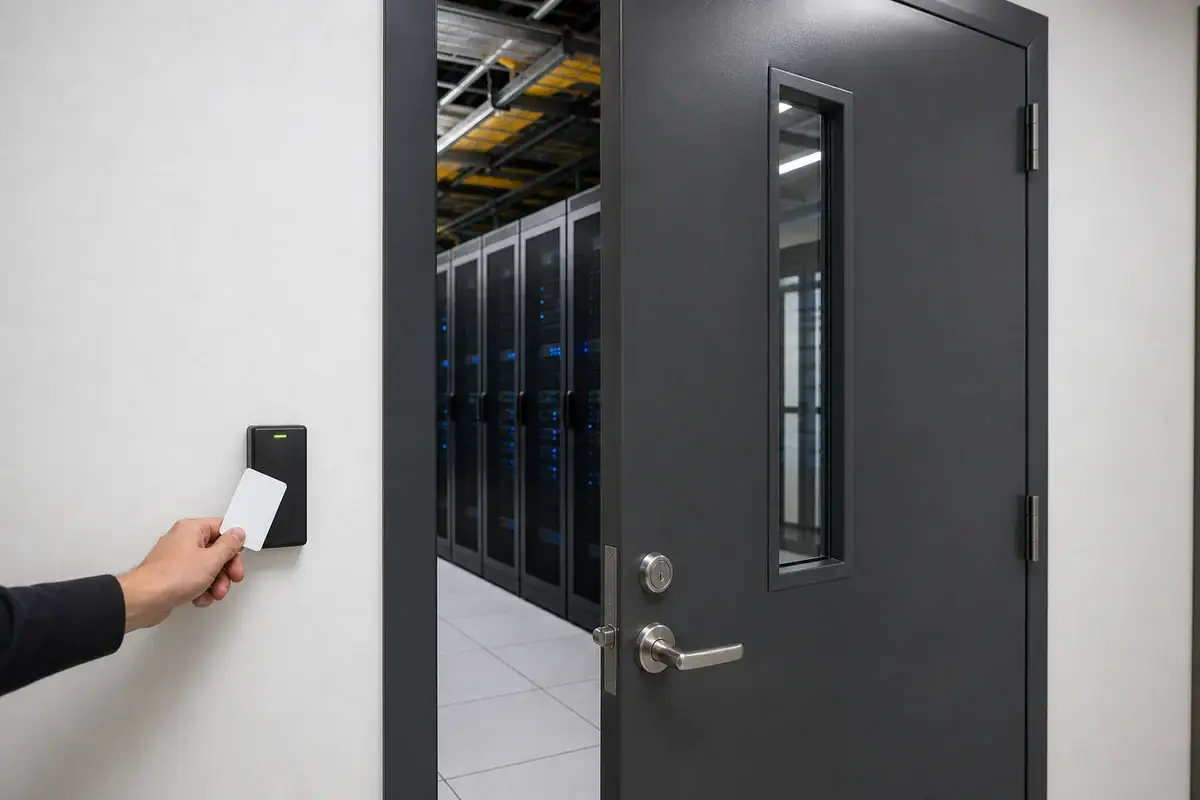
A server room, for example, may require a different access policy from a general employee entrance. A warehouse door may experience different traffic patterns from an executive office or controlled interior department.
ACG evaluates the operating purpose of each controlled point before recommending readers, credentials or supporting hardware so the access-control design reflects how the facility is actually used.
On-premise and cloud-managed access control
Commercial access-control platforms can be managed through different architectures. Some organizations use systems with management infrastructure located primarily on site, while others use cloud-managed platforms that provide browser or remote administrative capabilities according to the selected solution.
An on-premise approach may fit organizations that already maintain local security infrastructure or have specific requirements around system administration and integration. The organization remains responsible for the supporting environment required by the selected platform.
Cloud-managed access control can simplify certain administrative tasks by allowing authorized personnel to manage compatible systems without depending entirely on a traditional local server architecture. Actual capabilities depend on the platform, connectivity and licensing selected.
The correct decision should consider the organization’s IT model, number of locations, network reliability, administrative expectations, existing systems and long-term support strategy rather than assuming one architecture is universally better.
Access control alongside video, gates and intrusion alarms
An access-control event becomes more useful when it can be understood in the context of the rest of the facility. Organizations may want surveillance around controlled entrances, vehicle-entry processes around commercial gates or intrusion detection around areas that are normally secured after hours.
Commercial video surveillance can provide visual context around a controlled door or entrance when the system design supports that relationship. Camera placement should be based on the level of detail the security team actually needs rather than simply mounting a camera near every reader.
Vehicle entrances may also combine gate movement, authorization procedures and surveillance.
Intrusion alarms may form another layer of the security environment. Access control manages authorized entry, while intrusion detection may support the organization’s response to activity during periods or in areas where access is not expected.
What ACG needs to know before specifying an access control system
Access control should be designed around the doors, users and policies the organization actually has. A reader selection made before those requirements are understood can create unnecessary limitations later.
Before recommending a system, ACG evaluates factors such as:
- The number and type of doors or controlled entry points.
- Daily employee, visitor, contractor and delivery traffic.
- The credential methods and authorization policies the organization wants to use.
- Existing locks, readers, controllers and other door hardware that may remain in service.
- Available network connectivity and power at or near controlled openings.
- Audit, reporting, security-policy or compliance requirements that affect system administration.
These inputs help determine the appropriate architecture, hardware and deployment approach before equipment is selected.
How ACG scopes a commercial access control system
1. Define the access objectives
Identify which doors, gates or areas require managed authorization, who needs access and what the organization wants the system to accomplish at each controlled point.
2. Inspect doors and existing infrastructure
Review door types, locking hardware, existing readers or controllers, network connectivity, power and other conditions that affect implementation.
3. Select credential and management architecture
Evaluate card, mobile, biometric, PIN or multi-factor options along with cloud-managed or on-premise system requirements.
4. Configure permissions and commission the system
Establish approved user groups, schedules and permissions, then test controlled openings and administrative access according to the approved design.
5. Review expansion and lifecycle requirements
Consider future doors, additional locations, credential changes and other operational requirements so the system can be managed as the organization evolves.
Cloud-managed vs. on-premise access control
Both approaches can support commercial access control. The right fit depends on how the organization wants to administer the system and the infrastructure already available.
| Decision factor | Cloud-managed access control | On-premise access control |
|---|---|---|
| Management | Authorized administrators may manage compatible systems through cloud-based interfaces depending on the platform. | Management infrastructure is typically maintained within the organization's own environment. |
| Updates and maintenance | Some platform updates and services may be managed through the provider's cloud architecture. | The organization may maintain more of the local server, software and lifecycle environment. |
| Remote administration | Often designed to support remote administration when connectivity and permissions allow. | Remote administration depends on the organization's own architecture and security policies. |
| Integration | Integration options depend on the cloud platform and supported ecosystem. | May fit facilities with established local integrations or specific infrastructure requirements. |
| Best use | Organizations prioritizing centralized or distributed administration across compatible systems. | Organizations whose security or IT model is built around locally managed infrastructure. |
The decision should follow the organization’s operational, IT and security requirements rather than a general preference for one technology model.
Expanding or replacing an existing access control system
A new access-control project does not always begin with an empty building. Many organizations already have readers, controllers, locks, credentials or management software that may still serve part of the facility.
Before recommending a complete replacement, ACG can evaluate which components are compatible with the intended design, where aging or unsupported equipment creates limitations and whether a phased migration is practical.
Reader and credential compatibility, controller architecture, door hardware and software support all affect whether the better approach is expansion, partial modernization or replacement.
A requirements-first review helps avoid unnecessary rip-and-replace work while also preventing legacy equipment from limiting the security and administrative capabilities the organization actually needs.
Why organizations bring ACG into access control projects
Access control touches the physical door, the credential, the network, the management platform and the organization’s daily operating policies. Treating each of those as an isolated purchase can create integration problems later.
ACG Security Solutions works across access control, commercial video surveillance, biometric credentials, structured cabling, intrusion alarms, commercial gate systems and security consulting. That broader capability helps the team evaluate how controlled entry should fit the rest of the property.
The objective is not to prescribe the most complicated credential or the greatest number of controlled doors. It is to design an access-control system that supports the organization’s actual security and operating requirements.
- Commercial and enterprise access-control focus
- Card, mobile, biometric and multi-factor credential planning
- Cloud-managed and on-premise system evaluation
- Integration with surveillance and related security systems
- Requirements-first planning before hardware selection
Commercial access control FAQs
A commercial access control system manages authorization at specific doors, gates or restricted areas by requiring approved credentials such as cards, mobile devices, biometrics or PINs before entry is granted.
Traditional keys provide physical access but can be difficult to revoke without replacing or rekeying locks. Electronic access control can allow authorized administrators to change permissions according to the capabilities and policies of the selected system.
Yes, compatible commercial access-control platforms may support mobile credentials that use approved smartphones or devices as part of the authorization process.
Yes. Depending on the system design, fingerprint, face, iris or other biometric methods may be used as access-control credentials. The appropriate modality depends on the facility, enrollment process, privacy policies and security requirements.
Cloud-managed access control uses a compatible cloud-based platform to support administration of the access-control system. Specific remote-management, update and integration capabilities depend on the selected platform and connectivity.
Access control and video surveillance can be planned together so cameras provide useful visual context around controlled entrances or related security events when the selected systems support that integration.
Sometimes. Existing readers, controllers, credentials, locks and software should be reviewed for compatibility and lifecycle limitations before deciding whether expansion, phased modernization or replacement is the better approach.
Contact ACG Security Solutions with information about the property, number and type of doors, existing equipment, credential requirements and the way employees, visitors and contractors need to move through the facility.
Plan access control for your facility
Tell ACG which doors or areas need controlled entry, who needs access and what existing hardware or network infrastructure is already in place. The team can help evaluate credential methods, management architecture and the broader security systems that should work alongside access control.