
Quick answer
A mobile solar security tower is generally better suited to temporary, changing or infrastructure-limited surveillance needs. A permanent fixed camera system is generally better suited to stable, long-term camera positions with established power and network infrastructure. Many commercial properties use both approaches at different stages or in different parts of the site.
Why businesses compare mobile towers and fixed cameras
Commercial properties do not all need the same surveillance approach. A distribution center that expects to operate from the same facility for years has very different security requirements from an active construction project whose entrances, fencing and equipment areas may move repeatedly.
That is why the comparison between mobile solar security towers and permanent cameras should begin with the site condition rather than with camera specifications.
Neither system is universally better. They solve different problems.
What is a mobile solar security tower?
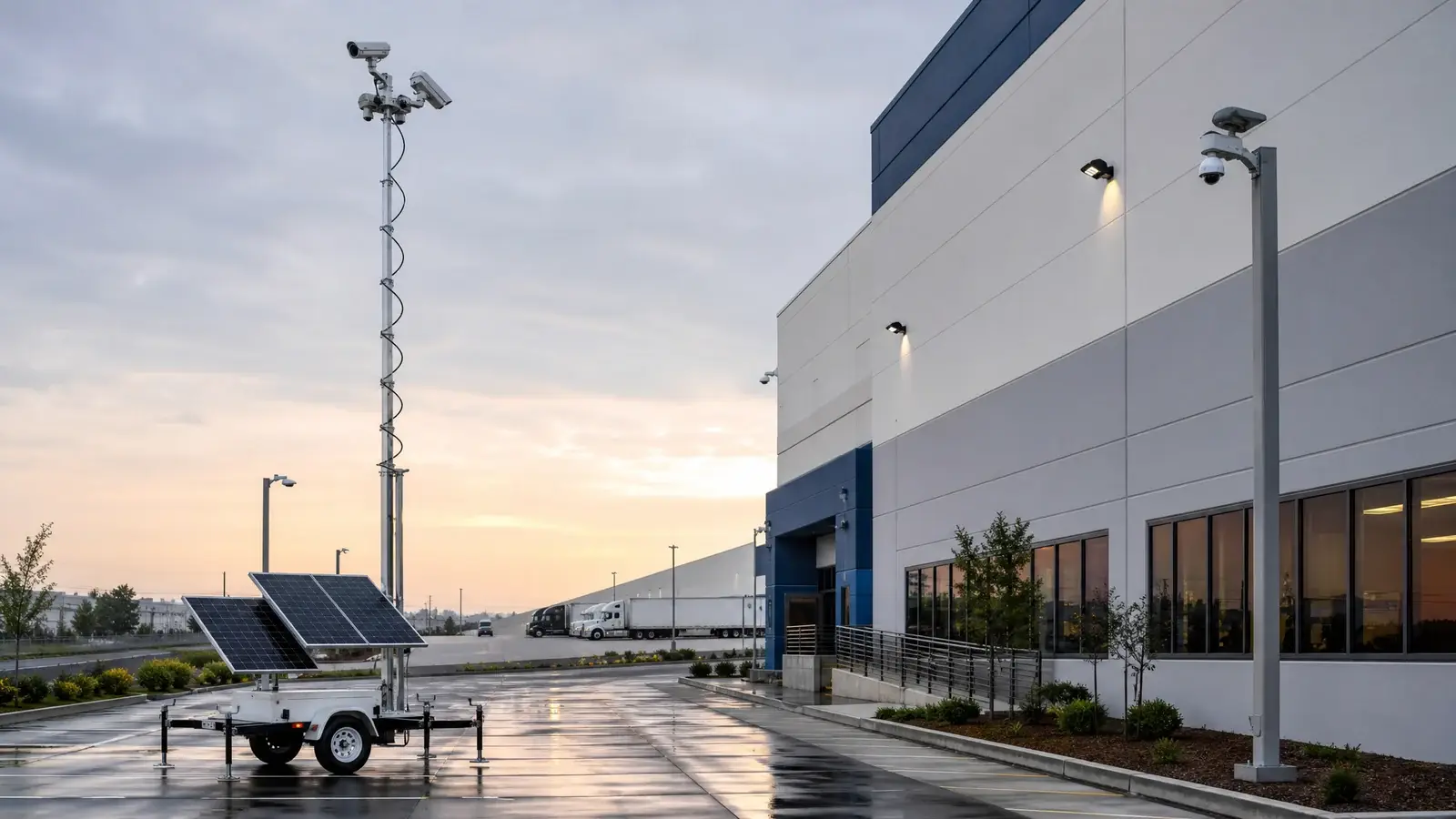
A mobile solar security tower is a transportable surveillance platform that places cameras and related technology on an elevated mast. Depending on the system design, the platform may support remote connectivity, recording, video analytics, thermal imaging or multisensor camera technology.
The primary advantage is flexibility. A tower can support surveillance where permanent mounting positions are unavailable, where infrastructure is incomplete or where the best camera position may change over time.
What is a permanent fixed camera system?
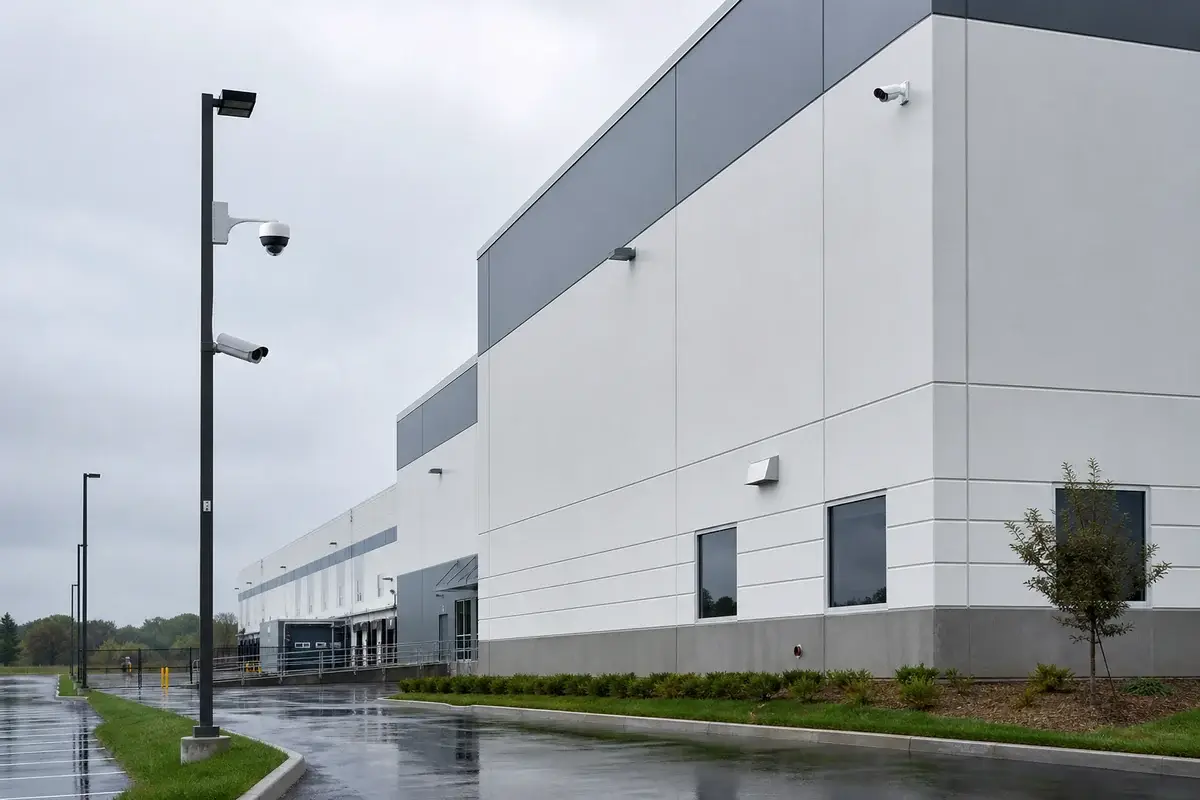
A permanent commercial surveillance system uses cameras installed at established locations such as buildings, poles, entrances, loading areas and interior spaces. These cameras can be designed around permanent power, networking, recording and video-management infrastructure.
Once a property’s security requirements are stable, fixed surveillance often provides the stronger long-term foundation because camera locations and supporting infrastructure can become part of the finished facility design.
The most important difference is the site condition
The real question is not whether a tower or fixed camera has the better specification sheet. It is whether the surveillance position is expected to remain useful.
If a project team can say, “We will need to monitor this entrance from this position for years,” a permanent camera may make sense.
If the answer is, “We need visibility here now, but this part of the site is going to change,” a mobile deployment becomes more attractive.
When mobile surveillance is a strong fit
Construction sites
Construction projects frequently need security before permanent power, network infrastructure or final camera locations exist. A mobile tower can provide coverage while the project develops and may be repositioned when site conditions permit.
Learn more about construction site security systems.
Temporary commercial operations
A temporary parking area, work zone or transitional property may need surveillance without becoming part of the permanent facility design.
Remote portions of large properties
Warehouse and logistics yards can extend far beyond the building. A mobile tower can provide an elevated camera position nearer to a remote operating area.
Changing perimeters
Sites undergoing expansion, redevelopment or phased occupancy may have changing security boundaries.
When permanent cameras are usually stronger
Stable entrances
Permanent vehicle, employee and visitor entrances generally benefit from surveillance designed as part of the long-term facility infrastructure.
Building interiors
Warehouses, offices and other established indoor spaces typically require fixed camera positions.
Long-term perimeter coverage
When the same portion of a property requires surveillance year after year, permanent mounting and networking can provide a more integrated solution.
Deep system integration
Fixed surveillance can be designed alongside access control, network infrastructure, gates and other long-term commercial security technologies.
Mobile towers and fixed cameras can work together
Many properties do not need an either-or answer.
A construction project may use mobile towers during early phases, begin installing permanent cameras as finished portions of the facility become available and eventually transition primarily to fixed surveillance after completion.
A warehouse may use permanent cameras around entrances, loading docks and interior operating areas while a mobile tower covers a temporary trailer lot or remote portion of the yard.
Read more about warehouse and logistics security systems.
What about video analytics and thermal imaging?
Analytics and thermal imaging are not exclusive to either deployment type.
Depending on the design, a mobile tower or permanent camera system may incorporate video analytics. Analytics can help focus attention on configured activity, but performance depends on placement, image quality, environment and proper configuration.
Thermal imaging may provide another way to visualize heat information in low-light or visually difficult environments.
Mobile vs. fixed surveillance comparison
| Decision factor | Mobile security tower | Permanent camera system |
|---|---|---|
| Site condition | Temporary, transitional or changing | Stable and long-term |
| Infrastructure | Useful when permanent infrastructure is limited or incomplete | Designed around established power, network and mounting positions |
| Repositioning | May be repositioned when conditions permit | Designed to remain in established positions |
| Building integration | Can supplement existing systems | Can integrate deeply with permanent facility infrastructure |
| Common fit | Construction, temporary areas and changing exterior coverage | Established entrances, interiors and long-term operations |
Questions to ask before choosing
- What exactly needs to be observed?
- How long will the current site configuration remain in place?
- Will the preferred camera position change?
- Is permanent power available?
- Is network connectivity available?
- Will the cameras eventually become part of a finished facility?
- Does the system need to integrate with access control or gates?
- Who needs access to live or recorded video?
Why an integrator can help with the decision
A provider that sells only mobile towers has an incentive to recommend a tower. A provider focused only on permanent cameras may approach the problem from the opposite direction.
ACG Security Solutions works across mobile surveillance, permanent commercial video surveillance, access control, analytics, thermal imaging and related commercial security technologies.
That allows the discussion to begin with the property requirement rather than the equipment category.
Frequently asked questions
Are mobile solar security towers better than fixed cameras?
Not universally. Mobile towers are generally better suited to temporary, changing or infrastructure-limited environments, while fixed cameras are typically better suited to stable long-term surveillance positions.
Can a mobile security tower replace permanent cameras?
It may provide surveillance in areas that otherwise could use fixed cameras, but the right long-term choice depends on the property, available infrastructure and whether camera locations will remain stable.
Are mobile towers useful for construction sites?
They can be particularly useful during construction because entrances, fencing, equipment areas and infrastructure can change throughout the project.
Can businesses use mobile and permanent surveillance together?
Yes. A mobile tower can supplement permanent surveillance around temporary, remote or changing portions of a commercial property.
Can both systems use video analytics?
Depending on the equipment and system design, either mobile or permanent surveillance may support video analytics.
When should a business install permanent cameras?
Permanent cameras are generally appropriate when surveillance locations are stable, power and networking are available and the requirement is expected to remain long term.
Choosing the right approach
The strongest surveillance system is not automatically the most mobile or the most permanent. It is the one that fits the property today while supporting where the operation is going next.
Request a commercial security assessment or call (866) 904-5353 to discuss the surveillance requirements for your property.
1 Comment
[…] Read the detailed comparison of mobile solar security towers vs. fixed cameras. […]